
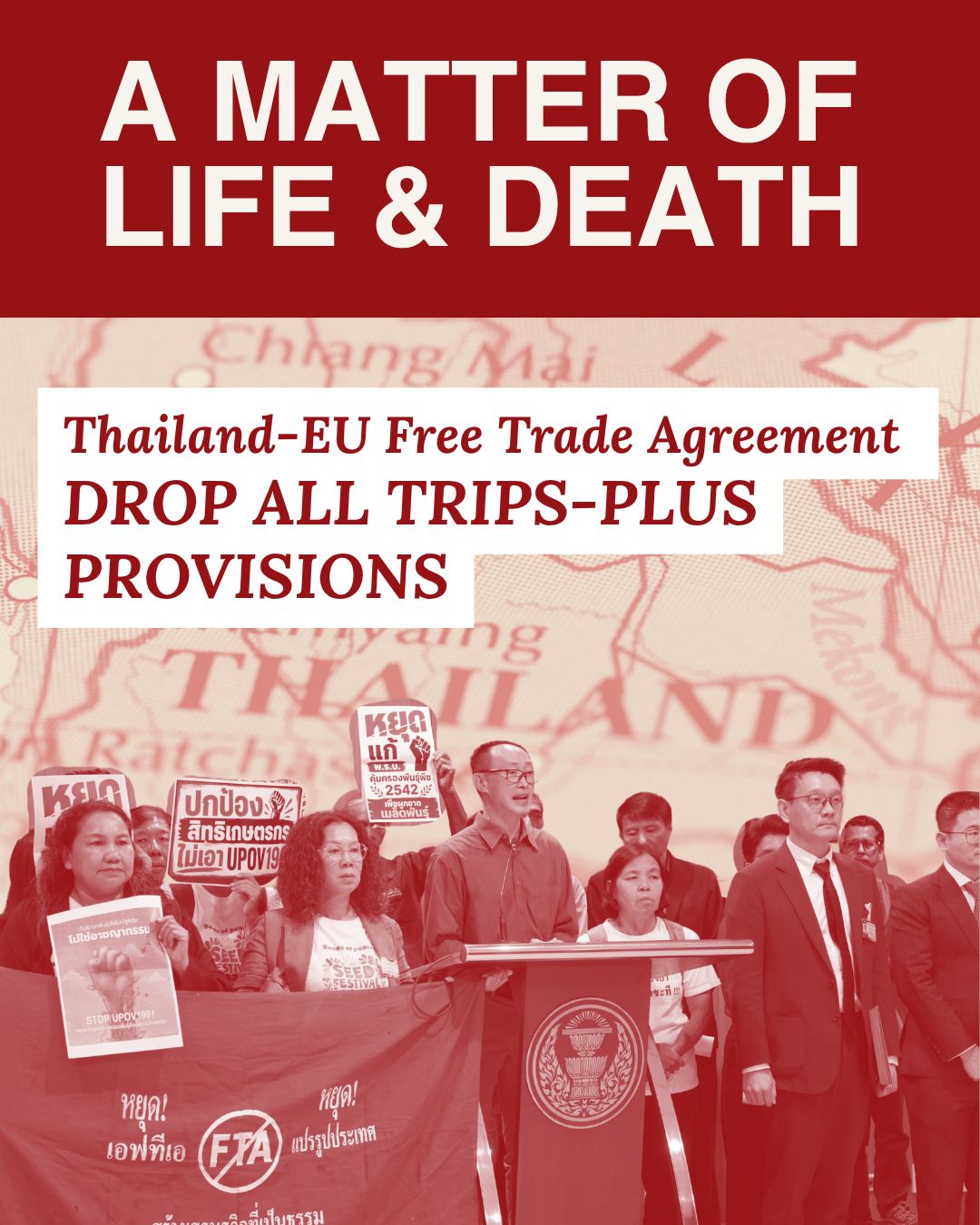
The Thai Network of People Living with HIV/AIDS (TNP+), a member of the Make Medicines Affordable (MMA) network, has joined a coalition of 146 Thai civil society organisations calling on the Thai government and Parliament to safeguard access to affordable medicines in negotiations on the Thailand-EU Free Trade Agreement (FTA).
On 17 September 2026, around 60 representatives of the coalition gathered at the Thai Parliament, where they met with members of relevant parliamentary committees and handed letters to four parliamentarians calling for greater scrutiny of the negotiations.
The upcoming tenth negotiating round is particularly important as the negotiations are approaching their final stage. While 15 of the agreement’s 24 chapters have already been provisionally concluded, several sensitive and contested issues remain unresolved, including intellectual property.
The joint letter raises concerns about a range of public-interest issues under negotiation, including access to medicines, farmers’ rights and plant variety protection under UPOV 1991, digital trade, alcohol policy and environmental protection. On medicines, the organisations called for Thailand to reject TRIPS-plus provisions, which are intellectual property protections that go beyond the World Trade Organization’s Agreement on Trade-Related Aspects of Intellectual Property Rights (TRIPS). These include data exclusivity, market exclusivity, supplementary protection certificates (SPCs) – a type of patent-term extensions, and other measures that could extend pharmaceutical monopolies and delay the entry of more affordable generic medicines. Additionally, FTA commitments should not restrict the government’s policy space to use public procurement to obtain affordable medicines or support local R&D and production. COVID-19 taught us an important lesson: countries need the capacity to produce and secure essential medicines rather than relying entirely on external supply.
Chalermsak Kittitrakul, Project Manager for Access to Medicines at TNP+ stated: “For people who depend on the public health system, intellectual property rules in a trade agreement are not simply technical trade issues – they can become a matter of life and death. Stricter IP provisions that prolong pharmaceutical monopolies could delay generic competition, significantly increase medicine prices and public health expenditure, and ultimately prevent patients from accessing the treatment they need.”
Kittitrakul stressed that Thailand must not accept TRIPS-plus provisions proposed by the EU and that Thailand must preserve the TRIPS flexibilities that have enabled the country to improve access to affordable medicines.
The coalition also called for greater transparency in the negotiations, meaningful consultation with patients and other affected communities before major commitments are accepted, and parliamentary scrutiny before and after the tenth negotiating round. It urged negotiators not to trade away access to medicines and other public interests in exchange for commercial benefits in other sectors.
The letter cites a 2025 study jointly conducted by the Thai Food and Drug Administration, the National Health Commission Office and an academic network, estimating that the EU’s intellectual property proposals could delay generic competition by up to eleven years and increase Thailand’s pharmaceutical expenditure by approximately US$3.9 billion over 10 years, US$23.2 billion over 20 years and US$111.5 billion over 30 years.
Such increases could place a substantial long-term burden on Thailand’s healthcare budget and undermine sustainable access to essential medicines at affordable prices. The letter also warns that these commitments could undermine the sustainability of universal health coverage and Thailand’s domestic pharmaceutical industry.
“Access to medicines is a core obligation under the right to health, not a bargaining chip. The EU presents human rights as a core value of its external relations, yet the TRIPS-plus demands it is pressing on Thailand would extend medicine monopolies, delay generic competition and put life-saving treatment out of reach. By pushing these rules, the EU risks becoming complicit in undermining the right to health of people in Thailand. ITPC calls on the EU to withdraw all TRIPS-plus demands from the negotiated text of FTA with Thailand,” said Othoman Mellouk, Access to Medicines and Health Technologies Lead at ITPC and coordinator of the Make Medicines Affordable campaign.
The tenth round of Thailand-EU FTA negotiations is scheduled to take place in Phuket from 28 September to 6 October 2026. The round is critical for ensuring that the remaining unresolved provisions do not compromise public health and other public interests.
Civil society networks, including MMA members, will continue campaign and communication activities ahead of and throughout the negotiating round, while calling on regional and international partners to support efforts to protect access to medicines and other public interests in the final agreement.
Facebook post of FTA Watch (in Thai language): https://www.facebook.com/ftawatch/posts/pfbid029roPigtnKx8Mm4cMrZuSZfTiXief5CCEyGorq3ZNR1vEsxtU5ZQM2LRCDmxpwaQ3l
The English version of the 146 Thai CSOs joint letter is available for download here: https://www.dropbox.com/scl/fi/z7p5t0gy9qwdut2ol5sa6/Thailand_EU_FTA_CSO_Letter_English_FINAL_REVIEWED_17Sep2026-88.docx?rlkey=1w3l4ynen5l9kqbxueu6g2ych&dl=0