
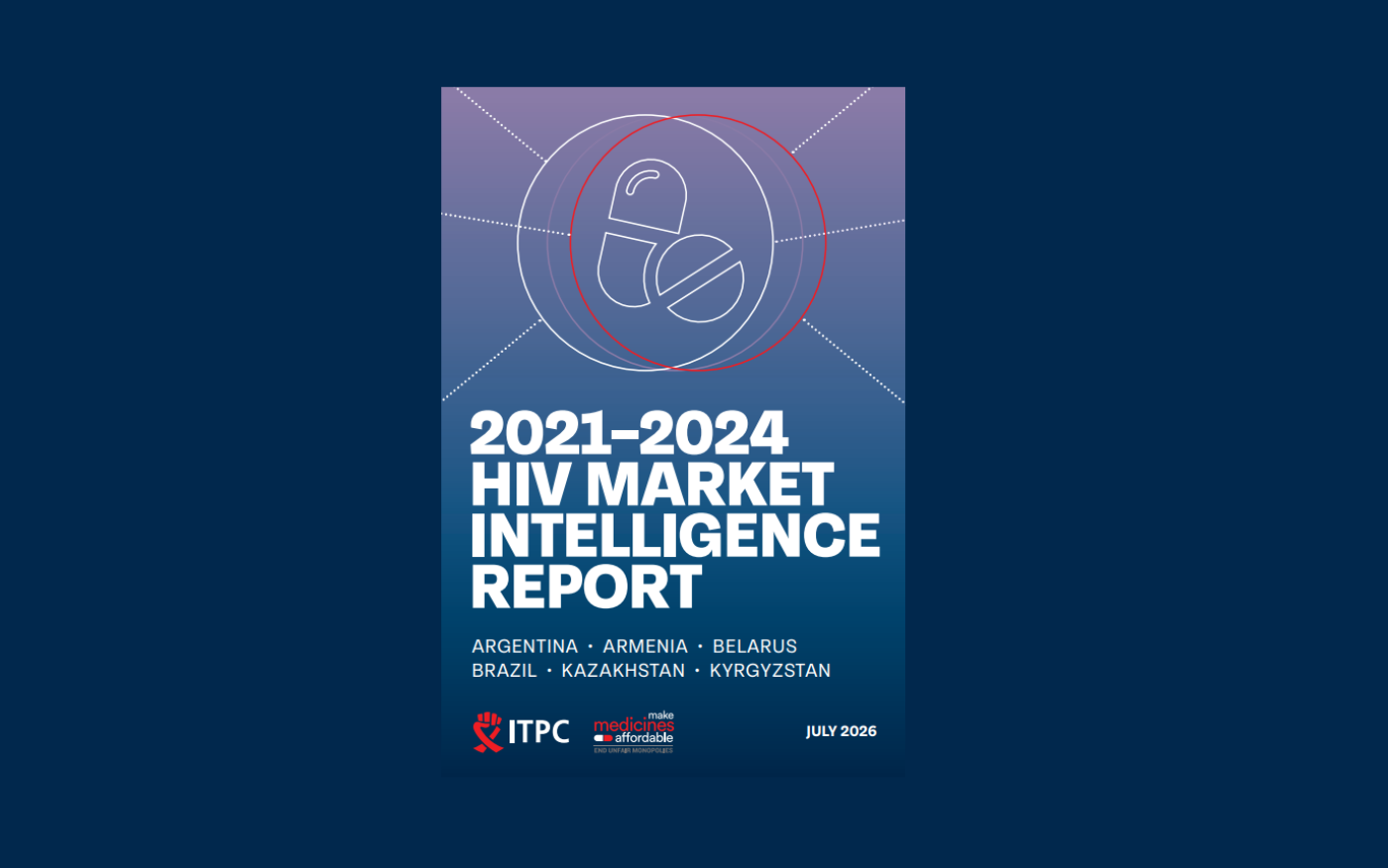
ITPC’s Make Medicines Affordable (MMA) Campaign published a new report today which reveals how patent monopolies, limited competition, and inefficient procurement continue to keep HIV medicines unnecessarily expensive.
The 2021–2024 HIV Market Intelligence Report examines the procurement, pricing and regulatory environments for antiretroviral medicines in six countries: Argentina, Armenia, Belarus, Brazil, Kazakhstan, and Kyrgyzstan.
The report brings together four years of evidence collected by community-based organizations who are MMA members. By analysing prices, purchasing volumes, suppliers, budgets, and procurement mechanisms, this market intelligence reveals where public resources are being lost to inflated prices, monopolies and avoidable inefficiencies.
While the report covers the period before recent cuts in U.S. funding for HIV programs, these developments make its findings even more relevant today. As funding becomes increasingly constrained, smarter procurement, greater market competition and more sustainable supply strategies will be critical to making the best use of limited resources and strengthening countries’ self-sufficiency.
“Market intelligence brings communities, civil society, governments, and local industry around the same table, while consortium-based work allows countries to share information globally and increase collective impact,” said Susana van de Ploeg, a a Brazilian lawyer, researcher, and activist with Brazilian Interdisciplinary AIDS Association (ABIA).
Inequalities persist despite progress toward better HIV treatment
The report documents a clear transition across the six countries towards dolutegravir-based treatment, in line with World Health Organization recommendations. Dolutegravir-containing regimens now represent most annual treatment courses and a substantial proportion of national antiretroviral budgets. Older, suboptimal regimens based on efavirenz and lopinavir/ritonavir are gradually being phased out, according to the report, although they continue to consume significant resources in some countries. However, this progress did not produce equal access to affordable treatment, the report indicated.
Prices secured through the Global Fund, PAHO, UNICEF and other international procurement mechanisms are frequently several times lower than those paid through national procurement. This creates a major accessibility issue, often overextending limited national budgets to procure HIV treatment. Fragmented purchasing, direct awards and single-supplier contracts weaken negotiating power and can allow prices to remain high even when affordable generic versions exist.
“In some countries in our EECA region, limited competition and single-supplier procurement have delayed the transition to affordable dolutegravir-based regimens,” said Sergey Golovin, the Make Medicines Affordable coordinator at ITPC Eastern Europe and Central Asia (EECA).
In Argentina, civil society patent oppositions prevented monopolies on tenofovir/emtricitabine and sofosbuvir, enabling generic production. Further research later revealed that procurement barriers were still restricting competition and keeping prices high. Advocacy informed by this evidence helped move procurement to the PAHO Strategic Fund, generating estimated annual savings of US$14.5 million for tenofovir/emtricitabine and US$0.98 million for sofosbuvir in 2021.
“Patent oppositions opened the door to lower-priced generics, but market intelligence showed that competition was still limited due to procurement-related barriers—which were also successfully overcome thanks to community groups’ advocacy,” said Lorena Di Giano, Executive Director of Fundación GEP.
Monopolies continue to drain HIV budgets
The report identifies high-priced patented medicines and quasi-monopolistic markets as major threats to sustainable HIV programmes. In Brazil, patent protection has contributed to a striking difference between the price paid nationally for dolutegravir and prices available through pooled international procurement. In Argentina, a single-supplier darunavir/ritonavir contract absorbed approximately 43% of the national HIV programme’s executed budget in 2024, with its unit price increasing nearly tenfold within less than two years.
The report also reveals how pediatric formulations are another area of concern as they are often purchased in small quantities at higher prices, while limited manufacturing and policies favour originator products further restrict competition.
The report raises concern over continuing transparency gaps, such as a lack of information on suppliers, prices, and purchasing volumes which remains incomplete in several countries, limiting the ability of communities to monitor public spending and identify access risks.
“This report shows that market intelligence equips communities with the evidence to identify unfair prices, challenge barriers, and propose practical solutions that can expand treatment access. Decision-makers involved in medicines procurement must strengthen transparency and work together with communities to ensure procurement decisions are informed by evidence and help build more equitable and sustainable HIV responses,” urged Morgane Ahmar, Impact Manager at ITPC.
MMA calls on governments to take clear action
The 2021–2024 HIV Market Intelligence Report calls on governments to prioritize open and competitive tenders, compare national prices systematically with international reference prices, pool purchasing volumes, and use international procurement channels when domestic products are unavailable or overpriced.
It also recommends accelerating the transition to WHO-recommended regimens, simplifying the registration of quality-assured generics (including pediatric formulations) and using TRIPS flexibilities such as patent oppositions and compulsory licensing when patents or data exclusivity prevent affordable access. Governments should publish comprehensive procurement data, protect civil society oversight and plan carefully for transitions from donor support to domestic financing. Doing so would usher in accessibility and affordability, enabling countries to spend HIV budgets more efficiently and thereby, provide treatment to more people.
Read the full 2021–2024 HIV Market Intelligence Report here.