
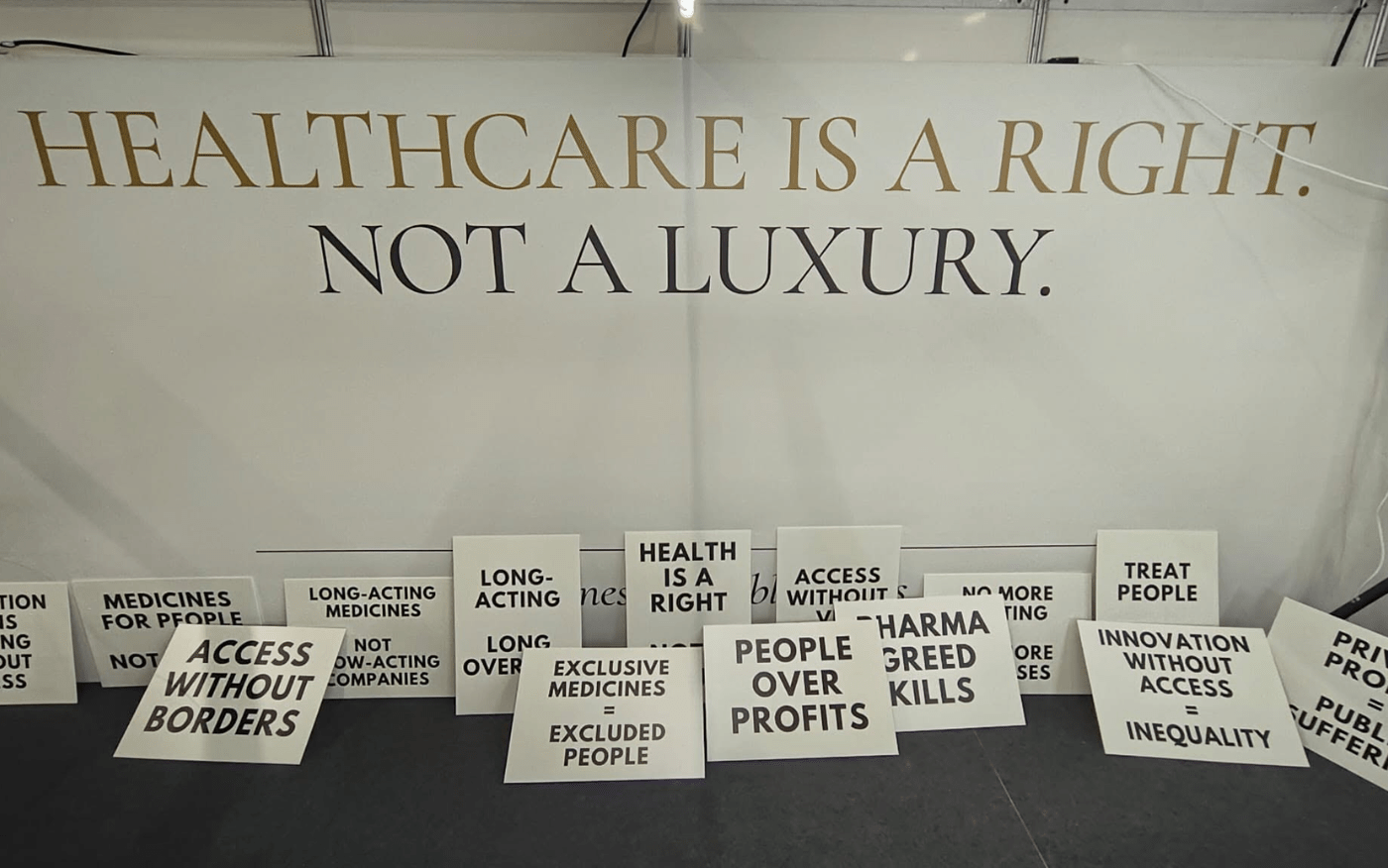
AIDS 2026, Rio de Janeiro, 28 July 2026
Merck’s early voluntary license (VL) for alimatravir (MK-8527) is being sold as a breakthrough in access, but it isn’t – it is the same corporate-controlled mechanism that continues to fail our communities – as they have with access to COVID-19 vaccines, treatment for drug-resistant tuberculosis, and long-acting HIV prevention. The terms of this VL include new restrictions, preventing countries from using legal measures to secure generic versions of alimatravir.
Tragically, the Merck VL follows the pattern of exclusion – set by Gilead and ViiV in their VLs for lenacapavir (LEN) and cabotegravir (CAB-LA) preventing excluded countries with high rates of new HIV acquisitions to access affordable generic versions of alimatravir – instead, they must pay whatever price Merck chooses to set – and it threatens to shift the burden of new infections, instead of truly contributing to the end of the epidemic.
On 24th July 2026, Merck announced seven voluntary licensing agreements for alimatravir (MK-8527), a once-monthly PrEP pill currently in phase III trials. Although Merck’s voluntary licenses (VLs) cover 129 countries, it excludes many of the same countries as the VLs for lenacapavir (LEN) and cabotegravir (CAB-LA), from Gilead and ViiV/ Medicines Patent Pool, respectively. These excluded countries must pay whatever price Gilead, ViiV, and Merck set for their long-acting HIV prevention products, instead of accessing affordable generic versions. As examples, LEN can be produced for an estimated $25–46 per person, per year (PPPY), yet it is priced at ~$28,218/year in the US. CAB-LA costs an estimated $15–23 PPPY to produce vs. the US price of ~$25,374 PPPY- over 1,100-fold higher.
An analysis of generic production costs from Andrew Hill and colleagues, presented today at the World AIDS conference, found that a year’s supply of alimatravir could be made for $3.
“It could be one of the cheapest HIV prevention tools ever made, yet alimatravir is licensed under an agreement built to control who can produce it, where it can be sold, and on whose terms,” says Andrew Hill, Senior Visiting Research Fellow of Department of Pharmacology and Therapeutics at the University of Liverpool.
Brazil, host of the World AIDS conference, was home to ~55,000 new HIV acquisitions in 2024 – yet it is excluded from Merck’s VL, as are Argentina, Chile, Colombia, Costa Rica, Ecuador, Mexico, Peru, Panama, Paraguay, and Uruguay – some of whom allowed companies to conduct clinical trials in their countries.
“This is not coincidence — it is what the voluntary license model reliably produces: the patent holder alone decides who gets access,” stresses Veriano Terto, deputy director at ABIA, Brazil. “This corporate strategy will enable the continued spread of HIV in Latin America — rather than ending the epidemic.”
Merck’s VLs set a dangerous precedent — that is even more restrictive than the relevant terms of VLs for LEN and CAB-LA. It prevents countries from using legal public health safeguards and their own national laws to import or produce generic alimatravir, and it forces generics manufacturers who sign the VL into producing generic versions of alimatravir for Merck at a very low price – which clearly intends to resell these generic versions at much higher prices.
Patent oppositions. Merck’s published Sample License Agreement (MSD VL) allows the company to terminate the license immediately if a licensee challenges the validity of Merck’s patent application or patents – which they have the legal right to do.
Parallel importation. The MSD VL bars licensees from selling outside its 129-country territory, on pain of termination. It also contains anti-diversion measures which prevent countries from using parallel importation (a legal mechanism that enables countries to import cheaper medicines under their national laws). None of the manufacturers who signed the VL are willing to risk termination to supply it to excluded countries.
Compulsory licensing: A compulsory license (CL) authorizes a country to produce a generic version of a branded medicine. This license locks up manufacturers who signed the VL, leaving excluded countries that issue a CL without suppliers.
In addition, the VL includes quality-standard deadlines and requirements for WHO prequalification and US FDA approval within a narrow timeline that trigger license termination, which will create problems for less experienced suppliers.
Often, generics manufacturers devise innovative methods to produce drugs more efficiently – but under the Merck VL, they must provide these improvements to Merck, who can use them to prolong the length of its patent monopoly on alimatravir.
“Stripped of its partnership language, the license positions Global South manufacturers to serve Merck’s commercial needs first, echoing an old extractive order under a royalty-free label,” – emphasises Allan Maleche, Executive Director of KELIN.
“People everywhere need access to effective long-acting HIV prevention and treatment. Instead of shifting the epidemic from one region of the world to others, we need to truly enable equitable access.” – says Othman Mellouk, Access to Diagnostics & Medicines Lead at the International Treatment Preparedness Coalition.
We, as the Make Medicines Affordable coalition of civil society and community-based organizations based in low- and middle-income countries, are calling for
1. Governments in excluded countries, including Brazil, to use TRIPS flexibilities, including compulsory licensing and strict application of patentability criteria to reject patent oppositions, rather than pay unaffordable prices set by Merck.
2. Generics manufacturers should not require Merck’s permission to produce alimatravir. Regional manufacturing capacity should be built through public investment and technology transfer, independent of any single company’s license terms, and independent generics manufacturers should file patent oppositions and seek compulsory licenses to remove patent barriers to generic versions of alimatravir.